GitHub - Yeachan-Heo/oh-my-claudecode: Teams-first Multi-agent orchestration for Claude Code
English | 한국어 | 中文 | 日本語 | Español | Tiếng Việt | Português






For Codex users: Check out oh-my-codex — the same orchestration experience for OpenAI Codex CLI.
Multi-agent orchestration for Claude Code. Zero learning curve.
Don't learn Claude Code. Just use OMC.
Get Started • Documentation • CLI Reference • Workflows • Migration Guide • Discord
Quick Start
Step 1: Install
/plugin marketplace add https://github.com/Yeachan-Heo/oh-my-claudecode /plugin install oh-my-claudecode
Step 2: Setup
/setup /omc-setup
Step 3: Build something
autopilot: build a REST API for managing tasks
That's it. Everything else is automatic.
Not Sure Where to Start?
If you're uncertain about requirements, have a vague idea, or want to micromanage the design:
/deep-interview "I want to build a task management app"
The deep interview uses Socratic questioning to clarify your thinking before any code is written. It exposes hidden assumptions and measures clarity across weighted dimensions, ensuring you know exactly what to build before execution begins.
Team Mode (Recommended)
Starting in v4.1.7, Team is the canonical orchestration surface in OMC. The legacy swarm keyword/skill has been removed; use team directly.
/team 3:executor "fix all TypeScript errors"
Team runs as a staged pipeline:
team-plan → team-prd → team-exec → team-verify → team-fix (loop)
Enable Claude Code native teams in ~/.claude/settings.json:
{ "env": { "CLAUDE_CODE_EXPERIMENTAL_AGENT_TEAMS": "1" } }
If teams are disabled, OMC will warn you and fall back to non-team execution where possible.
tmux CLI Workers — Codex & Gemini (v4.4.0+)
v4.4.0 removes the Codex/Gemini MCP servers (x, g providers). Use the CLI-first Team runtime (omc team ...) to spawn real tmux worker panes:
omc team 2:codex "review auth module for security issues" omc team 2:gemini "redesign UI components for accessibility" omc team 1:claude "implement the payment flow" omc team status auth-review omc team shutdown auth-review
/omc-teams remains as a legacy compatibility skill and now routes to omc team ....
For mixed Codex + Gemini work in one command, use the /ccg skill (routes via /ask codex + /ask gemini, then Claude synthesizes):
/ccg Review this PR — architecture (Codex) and UI components (Gemini)
Surface
Workers
Best For
omc team N:codex "..."
N Codex CLI panes
Code review, security analysis, architecture
omc team N:gemini "..."
N Gemini CLI panes
UI/UX design, docs, large-context tasks
omc team N:claude "..."
N Claude CLI panes
General tasks via Claude CLI in tmux
/ccg
/ask codex + /ask gemini
Tri-model advisor synthesis
Workers spawn on-demand and die when their task completes — no idle resource usage. Requires codex / gemini CLIs installed and an active tmux session.
Note: Package naming — The project is branded as oh-my-claudecode (repo, plugin, commands), but the npm package is published as
oh-my-claude-sisyphus. If you install or upgrade the CLI tools via npm/bun, usenpm i -g oh-my-claude-sisyphus@latest.
Updating
If you installed OMC via npm, upgrade with the published package name:
npm i -g oh-my-claude-sisyphus@latest
Package naming note: the repo, plugin, and commands are branded oh-my-claudecode, but the published npm package name remains
oh-my-claude-sisyphus.
If you installed OMC via the Claude Code marketplace/plugin flow, update with:
1. Update the marketplace clone
/plugin marketplace update omc
2. Re-run setup to refresh configuration
/omc-setup
Note: If marketplace auto-update is not enabled, you must manually run
/plugin marketplace update omcto sync the latest version before running setup.
If you experience issues after updating, clear the old plugin cache:
/omc-doctor
Your Claude Just Have been Steroided.

Why oh-my-claudecode?
- Zero configuration required - Works out of the box with intelligent defaults
- Team-first orchestration - Team is the canonical multi-agent surface
- Natural language interface - No commands to memorize, just describe what you want
- Automatic parallelization - Complex tasks distributed across specialized agents
- Persistent execution - Won't give up until the job is verified complete
- Cost optimization - Smart model routing saves 30-50% on tokens
- Learn from experience - Automatically extracts and reuses problem-solving patterns
- Real-time visibility - HUD statusline shows what's happening under the hood
Features
Orchestration Modes
Multiple strategies for different use cases — from Team-backed orchestration to token-efficient refactoring. Learn more →
Mode
What it is
Use For
Team (recommended)
Canonical staged pipeline (team-plan → team-prd → team-exec → team-verify → team-fix)
Coordinated Claude agents on a shared task list
omc team (CLI)
tmux CLI workers — real claude/codex/gemini processes in split-panes
Codex/Gemini CLI tasks; on-demand spawn, die when done
ccg
Tri-model advisors via /ask codex + /ask gemini, Claude synthesizes
Mixed backend+UI work needing both Codex and Gemini
Autopilot
Autonomous execution (single lead agent)
End-to-end feature work with minimal ceremony
Ultrawork
Maximum parallelism (non-team)
Burst parallel fixes/refactors where Team isn't needed
Ralph
Persistent mode with verify/fix loops
Tasks that must complete fully (no silent partials)
Pipeline
Sequential, staged processing
Multi-step transformations with strict ordering
Ultrapilot (legacy)
Deprecated compatibility mode (autopilot pipeline alias)
Existing workflows and older docs
Intelligent Orchestration
- 32 specialized agents for architecture, research, design, testing, data science
- Smart model routing - Haiku for simple tasks, Opus for complex reasoning
- Automatic delegation - Right agent for the job, every time
Developer Experience
- Magic keywords -
ralph,ulw,ralplan; Team stays explicit via/team - HUD statusline - Real-time orchestration metrics in your status bar
- Skill learning - Extract reusable patterns from your sessions
- Analytics & cost tracking - Understand token usage across all sessions
Custom Skills
Learn once, reuse forever. OMC extracts hard-won debugging knowledge into portable skill files that auto-inject when relevant.
Project Scope
User Scope
Path
.omc/skills/
~/.omc/skills/
Shared with
Team (version-controlled)
All your projects
Priority
Higher (overrides user)
Lower (fallback)
.omc/skills/fix-proxy-crash.md
name: Fix Proxy Crash description: aiohttp proxy crashes on ClientDisconnectedError triggers: ["proxy", "aiohttp", "disconnected"] source: extracted
Wrap handler at server.py:42 in try/except ClientDisconnectedError...
Manage skills: /skill list | add | remove | edit | search Auto-learn: /learner extracts reusable patterns with strict quality gates Auto-inject: Matching skills load into context automatically — no manual recall needed
Magic Keywords
Optional shortcuts for power users. Natural language works fine without them. Team mode is explicit: use /team ... or omc team ... rather than a keyword trigger.
Keyword
Effect
Example
team
Canonical Team orchestration
/team 3:executor "fix all TypeScript errors"
omc team
tmux CLI workers (codex/gemini/claude)
omc team 2:codex "security review"
ccg
/ask codex + /ask gemini synthesis
/ccg review this PR
autopilot
Full autonomous execution
autopilot: build a todo app
ralph
Persistence mode
ralph: refactor auth
ulw
Maximum parallelism
ulw fix all errors
ralplan
Iterative planning consensus
ralplan this feature
deep-interview
Socratic requirements clarification
deep-interview "vague idea"
deepsearch
Codebase-focused search routing
deepsearch for auth middleware
ultrathink
Deep reasoning mode
ultrathink about this architecture
cancelomc, stopomc
Stop active OMC modes
stopomc
Notes:
- ralph includes ultrawork: when you activate ralph mode, it automatically includes ultrawork's parallel execution.
swarmcompatibility alias has been removed; migrate existing prompts to/teamsyntax.plan this/plan thekeyword triggers were removed; useralplanor explicit/oh-my-claudecode:omc-plan.
Utilities
Provider Advisor (omc ask)
Run local provider CLIs and save a markdown artifact under .omc/artifacts/ask/:
omc ask claude "review this migration plan" omc ask codex --prompt "identify architecture risks" omc ask gemini --prompt "propose UI polish ideas" omc ask claude --agent-prompt executor --prompt "draft implementation steps"
Canonical env vars:
OMC_ASK_ADVISOR_SCRIPTOMC_ASK_ORIGINAL_TASK
Phase-1 aliases OMX_ASK_ADVISOR_SCRIPT and OMX_ASK_ORIGINAL_TASK are accepted with deprecation warnings.
Rate Limit Wait
Auto-resume Claude Code sessions when rate limits reset.
omc wait # Check status, get guidance omc wait --start # Enable auto-resume daemon omc wait --stop # Disable daemon
Requires: tmux (for session detection)
Monitoring & Observability
Use the HUD for live observability and the current session/replay artifacts for post-session inspection:
- HUD preset:
/oh-my-claudecode:hud setupthen use a supported preset such as"omcHud": { "preset": "focused" } - Session summaries:
.omc/sessions/*.json - Replay logs:
.omc/state/agent-replay-*.jsonl - Live HUD rendering:
omc hud
Notification Tags (Telegram/Discord/Slack)
You can configure who gets tagged when stop callbacks send session summaries.
Set/replace tag list
omc config-stop-callback telegram --enable --token <bot_token> --chat <chat_id> --tag-list "@alice,bob" omc config-stop-callback discord --enable --webhook <url> --tag-list "@here,123456789012345678,role:987654321098765432" omc config-stop-callback slack --enable --webhook <url> --tag-list "<!here>,<@U1234567890>"
Incremental updates
omc config-stop-callback telegram --add-tag charlie omc config-stop-callback discord --remove-tag @here omc config-stop-callback discord --clear-tags
Tag behavior:
- Telegram:
alicebecomes@alice - Discord: supports
@here,@everyone, numeric user IDs, androle:<id> - Slack: supports
<@MEMBER_ID>,<!channel>,<!here>,<!everyone>,<!subteam^GROUP_ID> filecallbacks ignore tag options
OpenClaw Integration
Forward Claude Code session events to an OpenClaw gateway to enable automated responses and workflows via your OpenClaw agent.
Quick setup (recommended):
/oh-my-claudecode:configure-notifications
→ When prompted, type "openclaw" → choose "OpenClaw Gateway"
Manual setup: create ~/.claude/omc_config.openclaw.json:
{ "enabled": true, "gateways": { "my-gateway": { "url": "https://your-gateway.example.com/wake", "headers": { "Authorization": "Bearer YOUR_TOKEN" }, "method": "POST", "timeout": 10000 } }, "hooks": { "session-start": { "gateway": "my-gateway", "instruction": "Session started for {{projectName}}", "enabled": true }, "stop": { "gateway": "my-gateway", "instruction": "Session stopping for {{projectName}}", "enabled": true } } }
Environment variables:
Variable
Description
OMC_OPENCLAW=1
Enable OpenClaw
OMC_OPENCLAW_DEBUG=1
Enable debug logging
OMC_OPENCLAW_CONFIG=/path/to/config.json
Override config file path
Supported hook events (6 active in bridge.ts):
Event
Trigger
Key template variables
session-start
Session begins
{{sessionId}}, {{projectName}}, {{projectPath}}
stop
Claude response completes
{{sessionId}}, {{projectName}}
keyword-detector
Every prompt submission
{{prompt}}, {{sessionId}}
ask-user-question
Claude requests user input
{{question}}, {{sessionId}}
pre-tool-use
Before tool invocation (high frequency)
{{toolName}}, {{sessionId}}
post-tool-use
After tool invocation (high frequency)
{{toolName}}, {{sessionId}}
Reply channel environment variables:
Variable
Description
OPENCLAW_REPLY_CHANNEL
Reply channel (e.g. discord)
OPENCLAW_REPLY_TARGET
Channel ID
OPENCLAW_REPLY_THREAD
Thread ID
See scripts/openclaw-gateway-demo.mjs for a reference gateway that relays OpenClaw payloads to Discord via ClawdBot.
Documentation
- Full Reference - Complete feature documentation
- CLI Reference - All
omccommands, flags, and tools - Notifications Guide - Discord, Telegram, Slack, and webhook setup
- Recommended Workflows - Battle-tested skill chains for common tasks
- Release Notes - What's new in each version
- Website - Interactive guides and examples
- Migration Guide - Upgrade from v2.x
- Architecture - How it works under the hood
- Performance Monitoring - Agent tracking, debugging, and optimization
Requirements
- Claude Code CLI
- Claude Max/Pro subscription OR Anthropic API key
Platform & tmux
OMC features like omc team and rate-limit detection require tmux:
Platform
tmux provider
Install
macOS
brew install tmux
Ubuntu/Debian
tmux
sudo apt install tmux
Fedora
tmux
sudo dnf install tmux
Arch
tmux
sudo pacman -S tmux
Windows
psmux (native)
winget install psmux
Windows (WSL2)
tmux (inside WSL)
sudo apt install tmux
Windows users: psmux provides a native
tmuxbinary for Windows with 76 tmux-compatible commands. No WSL required.
Optional: Multi-AI Orchestration
OMC can optionally orchestrate external AI providers for cross-validation and design consistency. These are not required — OMC works fully without them.
Provider
Install
What it enables
npm install -g @google/gemini-cli
Design review, UI consistency (1M token context)
npm install -g @openai/codex
Architecture validation, code review cross-check
Cost: 3 Pro plans (Claude + Gemini + ChatGPT) cover everything for ~$60/month.
License
MIT
Featured by OmC Contributors
Top personal non-fork, non-archived repos from all-time OMC contributors (100+ GitHub stars).
- @Yeachan-Heo — oh-my-claudecode (⭐ 11k)
- @junhoyeo — tokscale (⭐ 1.3k)
- @psmux — psmux (⭐ 695)
- @BowTiedSwan — buildflow (⭐ 284)
- @alohays — awesome-visual-representation-learning-with-transformers (⭐ 268)
- @jcwleo — random-network-distillation-pytorch (⭐ 260)
- @emgeee — mean-tutorial (⭐ 200)
- @anduinnn — HiFiNi-Auto-CheckIn (⭐ 172)
- @Znuff — consolas-powerline (⭐ 145)
- @shaun0927 — openchrome (⭐ 144)
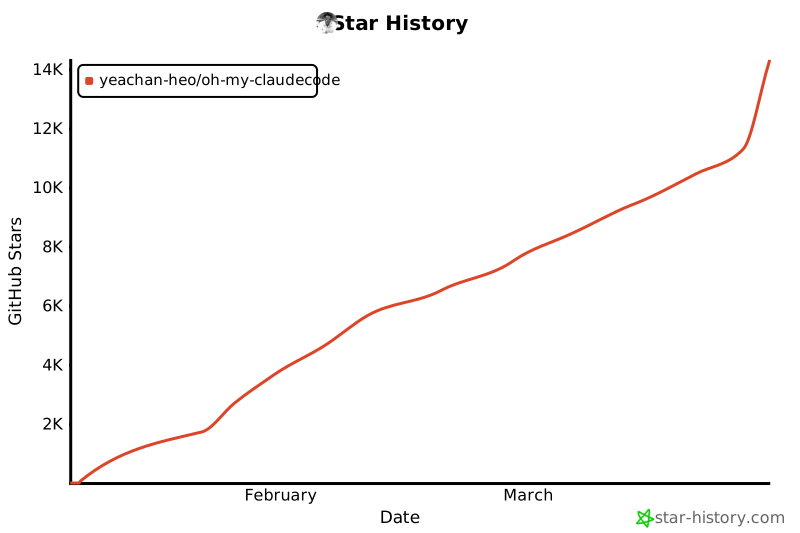
Star History
💖 Support This Project
If Oh-My-ClaudeCode helps your workflow, consider sponsoring:

Why sponsor?
- Keep development active
- Priority support for sponsors
- Influence roadmap & features
- Help maintain free & open source
Other ways to help
- ⭐ Star the repo
- 🐛 Report bugs
- 💡 Suggest features
- 📝 Contribute code